What is wingfoiling and why is it the trendiest sport?

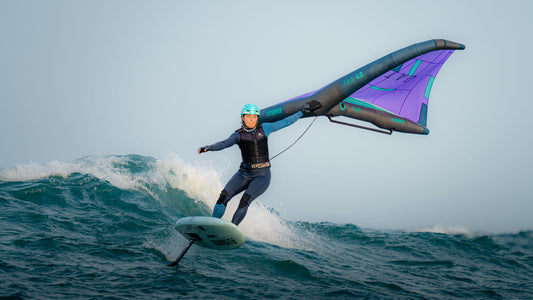
📸Wingfoiler vs kiter photo by @carulofotos
Wingfoiling is a new water sport that combines elements of windsurfing, kitesurfing, and foiling. It involves using an inflatable hand-held sail called a wing, which is held in the hands and harnesses the wind to propel the winger, wingfoiler, or rider, and a board with a hydrofoil or foil, which allows the rider to soar above the water with less friction and glide with greater speed and agility. It also improves upwind sailing in all directions.

Wingfoil and surfoil image 📸Photo: Arturo Vera.
Wingfoiling has many advantages that make it attractive to wind sports enthusiasts and thrill seekers. Some of these are:
- It's a simple and accessible sport. It doesn't require much equipment or preparation. All you need is a board, a wing, a leash, and a safety vest. The wing is easy to handle and isn't attached to the board or rider by any harness or rope, giving greater freedom of movement and control. For safety, both the board and wing are attached with a leash or bungee cord that allows for complete mobility.
- It's a versatile and adaptable sport. It can be practiced in a variety of wind conditions, from 10 to 40 knots—winds that are affordable in terms of equipment and safety—and in different types of water, from open ocean to lakes or rivers. You can also choose from different sizes and shapes of wings, boards, and foils, depending on each rider's level, weight, and style. And of course, the wind that will propel the entire group.
- It's a fun and exciting sport. It allows you to experience the sensation of flying over the water, surfing waves, performing jumps and tricks, or simply enjoying the scenery and nature. It's also a sport that fosters creativity and innovation, as it's constantly evolving and offers many opportunities to explore and improve.
- It's a healthy and eco-friendly sport. It helps improve cardiovascular endurance, strengthen core muscles, and improve balance and coordination. It's also an excellent way to connect with nature and respect the environment, as it doesn't generate noise or pollution.
If you want to get started wingfoiling or improve your technique, we recommend following these tips:
- First and foremost, contact a school. If I already know, you'll try to do it on your own with videos or a friend. Well, this has been tried before and it doesn't work out. I'll explain it to you as if you contact me, you'll waste time, money, and worst of all, you won't learn the basics.
The best school I can offer you is in Tarifa, as it could not be otherwise SUBCIELO KITESCHOOL .
- Choose your equipment carefully according to your level and your conditions. It's important, and a school will lend you that initial equipment in each lesson. Ideally, you should start with a large, buoyant board (at least 20 liters above your weight, and even 40 liters), a light and resistant wing, and a large, stable foil that allows you to balance at the beginning. The best schools are using wakeboarding with boats to accelerate your board learning process. As you progress, you can reduce the board size to below your weight (I go with -10) and the foil to gain speed and maneuverability. Keep in mind, future wingfoiler, that at the beginning you need winds between 15 and 20 knots. Okay, yes, I'm being very specific because if you have 12 knots, the momentum you need to exit smoothly and launch the foil is insufficient. On the other hand, if you're above 20 knots, you'll have more momentum, and due to your lack of stability, waves, and skill with the wing, you won't execute the maneuvers smoothly.
- Learn the basics of sailing. It's important to know how to steer the wing to the wind direction, how to tack or sail, how to gybe or tack, and how to control the wing's power.
- Practice in a safe and suitable location. Find an area with a steady wind, free of obstacles and currents. Read the article on winds I published a while back, Discover the different winds for kitesurfing: offshore, cross, onshore, and upwind . Avoid areas with heavy traffic or bathers. Respect safety rules and right-of-way guidelines. Always use a leash to avoid losing your wing or board. Floatation, whether in a vest, belt, or navigation equipment, can save your life.
- Enjoy the process and have fun. Don't get frustrated if you struggle at first to maintain balance or take off with the foil. In my case, coming from a kitefoil and handling the board with ease, it took me 30 hours to gain total control with downwind maneuvers and turns. Be patient and persevere. Try new things and push your limits. Share your experience with other riders and learn from them. I could spend all day writing advice, but it's from my perspective and may be biased. Not everything I tell you will be true. An instructor from an approved school will surely improve these 30 hours and with an evolving learning structure.

📸Photo: Arturo Vera
Wingfoiling is a sport that's here to stay and is gaining more and more followers around the world. If you want to be part of this community and experience a unique adventure on the water, don't hesitate and give it a try! Here's a video of me explaining my limited experience 😜🤙
You're not following @sueltaelwing yet 🤣💦 Go to Instagram and share Wingfoil images by tagging @sueltaelwing